





How to Choose the Best GRC Platform for UAE Enterprises (2026 Comparison)

For enterprise leaders in the UAE, 2026 marks a turning point. The regulatory landscape has shifted from "periodic checks" to "continuous enforcement." Between the maturing UAE Data Protection Law (PDPL), the rigorous Information Assurance (IA) standards of NESA, and the sector-specific mandates like ADHICS in healthcare and Dubai ISR, the cost of non-compliance is no longer just a fine: it’s a disruption to national digital transformation initiatives.
Choosing a GRC platform in this environment is no longer about finding a digital filing cabinet for your certificates. It is about selecting a strategic engine that can predict breaches, quantify risk in Dirhams, and automate the grueling work of manual compliance mapping.
This guide compares the legacy GRC landscape against modern AI-driven solutions, providing a framework for C-suite executives and security teams to evaluate the best regulatory compliance software for the Middle East market.
The 2026 Reality: Why Your Legacy GRC is Failing
Legacy GRC tools were built for a different era. They were designed as systems of record: static databases where teams manually uploaded evidence once a year. In a high-velocity market like Dubai or Abu Dhabi, this "point-in-time" approach creates a dangerous "compliance gap."
- Traditional GRC: Relies on manual data entry, spreadsheets, and reactive reporting. It tells you what went wrong six months ago.
- AI-Powered GRC (The 2026 Standard): Utilizes continuous control monitoring (CCM) and predictive analytics to tell you what will go wrong in the next 30 to 90 days.
For a UAE enterprise, the choice is clear: you either manage risk in real-time or you manage a crisis after the fact.
Strategic Comparison: Traditional vs. AI-Driven GRC
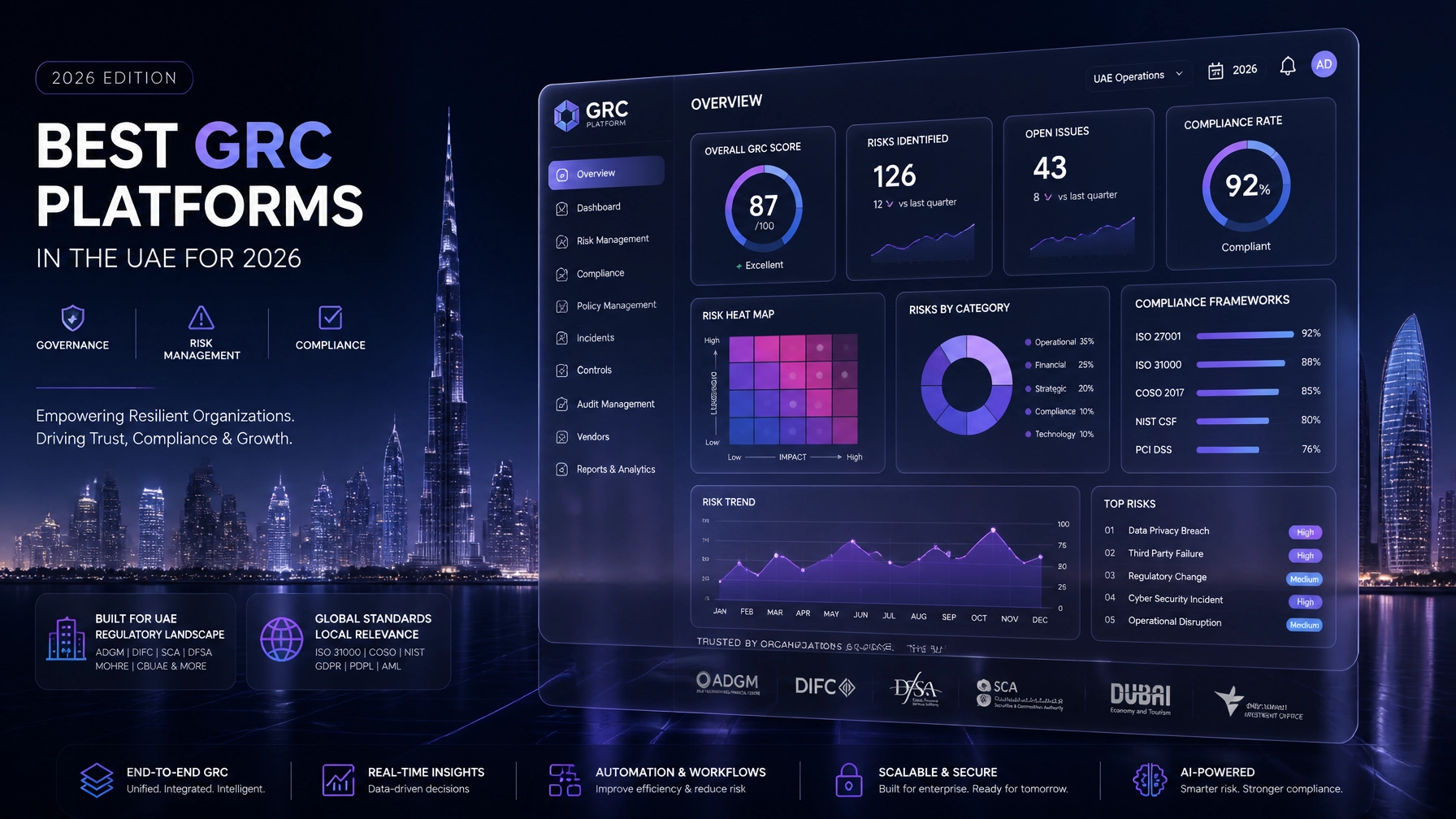
When evaluating a GRC platform UAE / Middle East organizations must look beyond the feature list and focus on "time-to-value" and "decision velocity."
| Feature | Legacy GRC Systems | Observeri AI-Powered Platform |
|---|---|---|
| Data Collection | Manual uploads & periodic surveys | Automated evidence mapping via 400+ API integrations |
| Risk Perspective | Abstract "High/Medium/Low" scores | Cyber risk quantification (Financial impact in $) |
| Audit Cycle | 3-6 months of manual preparation | Compressed audit cycles via continuous readiness |
| Compliance Mapping | Manual cross-referencing of controls | AI-automated mapping across ISO, NESA, ADHICS |
| Predictive Power | None (Reactive) | 30-90 day breach prediction window |
| ROI (Year 1) | Negative to 1X (due to heavy implementation) | 12-27X ROI |
1. Local Regulatory Depth: NESA, ADHICS, and Beyond
A generic global GRC platform often fails to account for the nuances of UAE-specific mandates. The best regulatory compliance software for this region must come pre-configured with localized frameworks.

NESA & SIA Compliance
The National Electronics Security Authority (NESA) requirements are non-negotiable for critical infrastructure. Modern platforms like Observeri automate the mapping of these technical controls, ensuring that evidence collected for an ISO 27001 audit simultaneously satisfies NESA IA standards. This "collect once, satisfy many" approach eliminates redundant work for compliance teams.
ADHICS (Abu Dhabi Healthcare Information & Cyber Security)
For healthcare providers in Abu Dhabi, ADHICS compliance is a major operational hurdle. Choosing a platform that understands the specific data residency and privacy requirements of the Department of Health (DoH) is critical for maintaining license to operate and patient trust.
2. Transitioning to Cyber Risk Quantification (FAIR Modeling)
The era of abstract "red-amber-green" heatmaps is over. In 2026, the Board of Directors demands to know: "If we are breached, what is the financial impact on our bottom line?"

The best GRC platforms now integrate cyber risk quantification using FAIR-style modeling. This translates technical vulnerabilities into an Expected Annual Loss (EAL).
By expressing risk in monetary terms, the CISO can move from being a "cost center" to a strategic partner. Instead of asking for "better firewalls," the CISO can present a case for reducing a $5M potential loss to $500K through a specific $100K investment. This is the language of the CFO and the CEO.
3. Automation and the "Insight Wheel"
The core of any modern GRC strategy is the integration of governance, risk, and compliance into a single, automated workflow. This is best visualized through the Insight Wheel, which represents how data flows from technical controls into strategic decisions.

Description: A colorful segmented ring chart representing integrated GRC functions: governance, risk, compliance, and analytics. Each segment illustrates how Observeri’s AI platform unifies and automates these components, enabling clear visualization of risk and compliance status.
For UAE enterprises, this wheel represents the shift from administrative burden to strategic advantage. When your GRC platform automatically maps evidence, your compliance team stops being "document collectors" and starts being "risk analysts."
4. Predictive Risk Analytics: Stopping Breaches Before They Happen
In 2026, reactivity is a liability. The most advanced GRC platform UAE / Middle East options leverage AI to identify patterns that human analysts might miss.

Observeri’s predictive engine analyzes your internal telemetry alongside global threat intelligence to predict potential breach windows. This allows organizations to focus remediation efforts on the vulnerabilities that are most likely to be exploited in the next 30 to 90 days.
This Vulnerability Prioritization contextualizes technical risks based on business value. If a server contains non-sensitive data and has no external exposure, it shouldn't be a priority: even if it has a "High" CVSS score. Modern GRC focuses your resources where they move the needle.
The ROI Factor: Why Speed Matters
Enterprise software is often criticized for long "time-to-value." Many legacy GRC implementations take 12 to 18 months to show results.
In the current UAE economic climate, that is unacceptable. Observeri is engineered for a breakeven point in just 21 days. By automating the initial mapping and providing immediate visibility into "Expected Annual Loss," organizations can see a 12-27X ROI within the first year.
Decision Checklist for UAE Enterprises:
- Does it support local frameworks (NESA, ADHICS, ISR) out of the box?
- Can it quantify risk in financial terms ($/AED)?
- Does it offer continuous monitoring, or just manual evidence uploads?
- Is there a predictive component for proactive breach prevention?
- What is the verified time-to-value?
Conclusion: Lead with Observeri
Choosing the right GRC platform is a decision that impacts the entire organization's resilience and strategic agility. For UAE enterprises looking to lead in 2026, the choice isn't just about software: it's about moving from a reactive posture to a predictive, quantified, and automated reality.
Observeri provides the only AI-powered platform designed specifically to bridge the gap between technical security data and boardroom-ready financial narratives. We don't just help you check boxes; we help you master compliance and minimize risk with surgical precision.
Ready to see your risk in Dirhams?
Explore the Observeri Platform and discover how we compress audit cycles and deliver 27X ROI for Middle East enterprises.