





Boardrooms Are Giving CISOs a ‘Needs Improvement’ on Future Risk : Here’s How to Fix It
For years, the CISO’s seat at the board table was secured by reporting on the "now." If patches were deployed, incidents were contained, and compliance checkboxes were green, the update was considered a success.
That era is officially over.
According to the IANS Research April 2026 report, the boardroom’s patience with retrospective data has worn thin. While 82% of directors are satisfied with how CISOs report on regulatory trends and current compliance, they are sounding a loud alarm on the one area that actually protects the company’s future: evolving threat analysis.
The data is sobering: 53% of board directors state that CISO reporting on the impact of evolving threats "needs improvement." Worse yet, only a staggering 6% rate future-risk reporting as "excellent."
The message from the board is clear: Stop telling us what happened last quarter. Tell us what is going to happen next quarter, and tell us how much it will cost.
The Boardroom Report Card Gap: Why the Disconnect?
The mismatch between CISO reporting and board expectations isn't due to a lack of effort. It’s a lack of the right language. Most security teams are still tethered to technical metrics: vulnerability counts, mean time to remediate (MTTR), and phishing simulation scores.
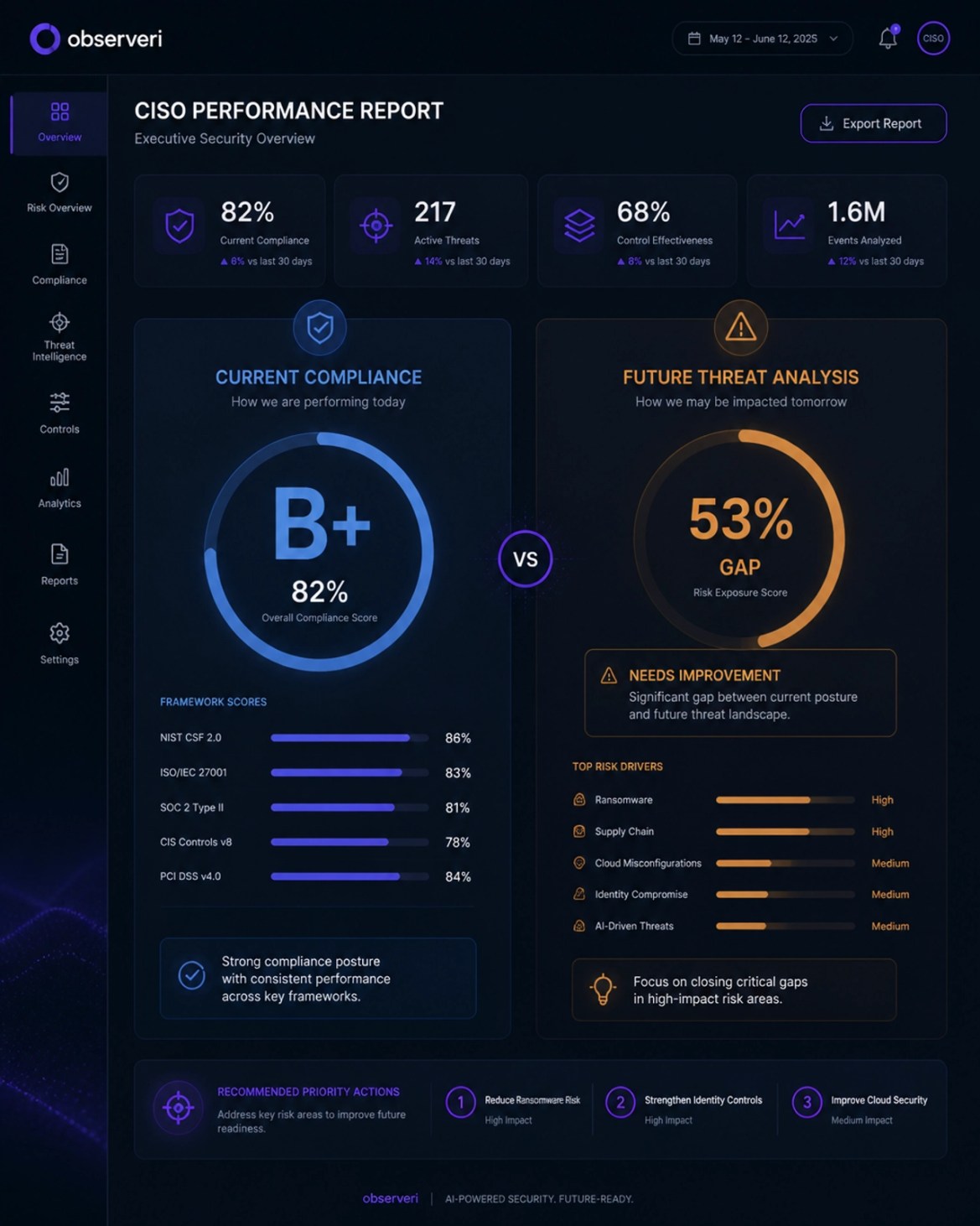
While these metrics demonstrate activity, they fail to demonstrate strategic resilience. The IANS 2026 benchmark highlights that boards feel under-informed on the very risks that define the modern landscape:
- Impact of Evolving Threats: 53% need improvement.
- AI-Driven Risk: 47% need improvement.
- Cyber Business Risk Assessment: 41% need improvement.
When a CEO asks, "Are we safe?" they aren't asking if you patched 10,000 servers. They are asking if the company's $500M revenue stream is protected against the breach trends expected in the next 90 days. If your reporting doesn't bridge that gap, you aren't managing risk: you're just managing a budget.
The Reactive Trap: Why "Current-State" Reporting is a Liability
Traditional GRC (Governance, Risk, and Compliance) is inherently backward-looking. It relies on point-in-time audits and manual spreadsheets that are outdated the moment they are saved. In a landscape where attackers move at the speed of automated AI, a quarterly compliance report is essentially a post-mortem.
Relying on "current-state" reporting creates a false sense of security. You might be 100% compliant with ISO 27001 today, but if an emerging ransomware strain is targeting your specific supply chain footprint, your compliance score won't stop the breach.
To satisfy the board’s 2026 mandate, CISOs must shift from reactive defense to predictive governance. This requires a move away from abstract heat maps (red/yellow/green) toward automated compliance management and predictive analytics.
Horizon Scanning: The Shift to Predictive Risk Analytics
The fix for a "Needs Improvement" grade lies in predictive cyber risk analytics. This isn't about a crystal ball; it’s about using AI to correlate internal vulnerability data with external threat intelligence and business context.

Instead of reporting on what occurred, modern CISOs are using Observeri’s platform to provide "Horizon Scanning." This enables the security team to:
- Forecast Breaches: Identify potential exploit paths 30-90 days before they are utilized.
- Quantify Exposure: Translate those technical paths into financial narratives.
- Prioritize Remediation: Focus on the 2% of vulnerabilities that pose 90% of the financial risk.
By presenting a forward-looking view, the CISO moves from being a "cost center manager" to a "strategic risk advisor." You are no longer just asking for more budget; you are presenting a business case for protecting "Expected Annual Loss."
Translating Technical Threats into Financial Realities
The board speaks the language of dollars, not CVEs. The most effective way to fix future-risk reporting is through Cyber Risk Quantification (CRQ) using models like FAIR (Factor Analysis of Information Risk).

At Observeri, we empower CISOs to express cyber exposure in terms of Expected Annual Loss (EAL).
| Metric Category | Legacy Reporting (Backward-Looking) | Predictive Reporting (Observeri Approach) |
|---|---|---|
| Risk Score | "High Risk" (7.8/10) | $4.2M Expected Annual Loss |
| Vulnerabilities | 500 Unpatched Criticals | 3 Critical Paths impacting top revenue lines |
| Timeline | Last Quarter's Incidents | 30-90 Day Breach Probability |
| ROI | "Improved Security Posture" | 27X ROI via prioritized risk reduction |
When you can tell the CFO, "By investing $200k in this specific control, we reduce our Expected Annual Loss by $1.5M over the next 6 months," the conversation changes instantly. You have successfully translated a technical threat into a financial decision.
How to Restructure Your Next Board Deck: A 4-Step Blueprint
To move your "evolving threat" rating from "Needs Improvement" to "Excellent," follow this practical restructuring for your next board presentation:
1. Lead with the Forecast, Not the History
Spend only 10% of your time on what happened last quarter. Dedicate the remaining 90% to the next 90 days. Start with: "Based on current telemetry and emerging sector threats, our predictive exposure for Q3 is $X million."
2. Contextualize AI and Emerging Tech Risks
As per the IANS data, boards are terrified of what they don't know about AI. Use Observeri's Predictive Risk Analytics to show how you are governing non-human identities and AI agents. Demonstrate that you have a map for the "unknowns."
3. Replace Heat Maps with Dollar Ranges
Stop using 5×5 grids. They are subjective and provide zero "decision velocity." Replace them with financial ranges. Show the "Best Case," "Worst Case," and "Most Likely" financial impact of your top three evolving threats.
4. Link Controls to Business Outcomes
Instead of listing tools, list protected outcomes. "Our investment in automated compliance mapping has compressed our audit cycle by 60%, allowing the team to focus on the predictive remediation of our high-value transaction environment."
The Cost of Inaction
The board’s dissatisfaction isn't just a critique of your slides; it's a reflection of their own anxiety regarding fiduciary responsibility. In the 2026 regulatory environment, "we didn't see it coming" is no longer a valid defense.
Enterprises using Observeri see a 12-27X ROI in their first year precisely because they stop wasting resources on "fixing everything" and start focusing on "fixing what matters."
If you are still providing backward-looking reports, you are leaving your organization: and your career: vulnerable to the next "evolving threat." It’s time to move beyond the spreadsheet. It’s time to provide the foresight the board is demanding.
Ready to transform your board reporting from "Needs Improvement" to "Strategic Asset"?
Explore Observeri's Predictive Risk Platform and start quantifying your future today.