





Best GRC Platforms in the UAE for 2026: A Neutral Guide for Compliance and Risk Teams
The UAE regulatory landscape in 2026 is no longer a matter of checking boxes or maintaining static spreadsheets. With the transition of the National Electronic Security Authority (NESA) to the Information Assurance Standards (IAS) v2: now managed by the Security and Information Agency (SIA): the stakes for enterprise compliance have shifted from administrative to strategic.
Today, 188 controls across 18 domains are the baseline. For government entities, semi-government authorities, and Critical Information Infrastructure (CII) operators, compliance is mandatory, continuous, and evidence-driven. Failing to demonstrate real-time risk visibility isn't just a security gap; it’s a failure of governance that carries heavy financial and operational penalties.
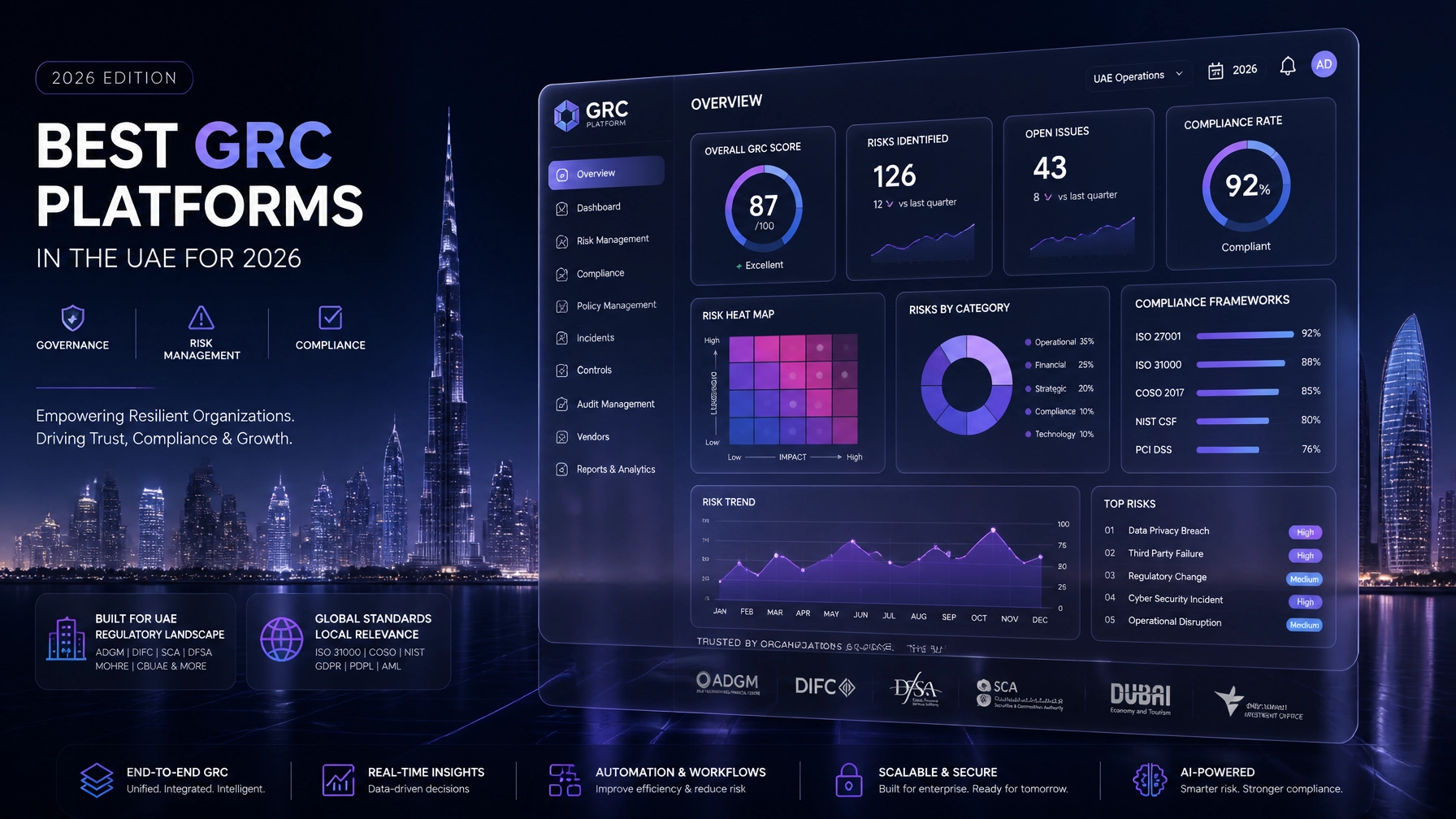
If you are evaluating GRC platforms in the UAE for 2026, the goal is not simply to find a document repository. Most enterprise teams need a platform that can support continuous compliance, centralize policies and controls, track risk consistently, and help them stay audit-ready across frameworks such as UAE PDPL, ADHICS, NCA-ECC, ISO 27001, and NESA IAS v2.
Below is a neutral list of widely used and regionally relevant options. Each platform has a different fit depending on your size, regulatory exposure, internal resources, and reporting requirements.
1. Observeri
Best for: Organizations looking for AI-driven risk analytics, cyber risk quantification, and automated compliance workflows.
Strengths:
- Combines governance, risk, and compliance workflows in a single platform.
- Supports cyber risk quantification with financial modeling such as Expected Annual Loss.
- Emphasizes automation for compliance mapping, evidence collection, and risk assessment.
- Designed to help teams move beyond spreadsheet-based audit preparation.
Limitations:
- May be more aligned to organizations that want advanced analytics rather than basic policy management alone.
- Teams looking for a very broad legacy ecosystem may compare it against larger incumbent platforms with longer integration histories.
2. ServiceNow IRM
Best for: Large enterprises already standardized on the ServiceNow ecosystem.
Strengths:
- Strong integration with ServiceNow ITSM, asset, workflow, and operations modules.
- Useful for organizations that want risk and compliance processes closely tied to service management.
- Well-suited to complex enterprise environments with mature internal platform teams.
Limitations:
- Implementation can be resource-intensive.
- Configuration complexity may be high for organizations without dedicated ServiceNow expertise.
- Total cost and rollout time can be significant compared with lighter platforms.
3. RSA Archer
Best for: Enterprises that need deep customization and highly tailored workflows.
Strengths:
- Long-established platform with broad use in large enterprises.
- Highly configurable for custom governance, risk, audit, and compliance processes.
- Often selected where organizations need detailed control over workflow design and reporting structure.
Limitations:
- Can be complex to implement and maintain.
- Customization often requires significant administrative effort or outside consulting support.
- User experience may feel heavier than newer platforms.
4. MetricStream
Best for: Large organizations managing multi-jurisdiction regulatory complexity.
Strengths:
- Broad GRC coverage across compliance, audit, policy, and enterprise risk management.
- Useful for organizations operating across multiple regions with overlapping requirements.
- Strong fit for enterprises that need centralized oversight across business units and frameworks.
Limitations:
- Can be a substantial deployment in terms of time, budget, and process design.
- Some teams may find the interface less intuitive than more modern SaaS-focused products.
- May be more platform than smaller organizations need.
5. VComply
Best for: Mid-sized organizations seeking a simpler path out of manual tracking and spreadsheets.
Strengths:
- Generally easier to adopt than heavier enterprise platforms.
- Clear focus on policy management, accountability, task assignment, and compliance tracking.
- Suitable for teams that want a structured GRC process without a long transformation program.
Limitations:
- May offer less depth for highly technical risk analysis or complex enterprise-scale use cases.
- Organizations with extensive automation or integration requirements may need more advanced capabilities.
- Better suited to straightforward governance programs than highly customized environments.
6. ArborGRC
Best for: UAE and GCC organizations that value regional alignment and local regulatory context.
Strengths:
- Focus on regional compliance expectations and localized operational needs.
- Can be attractive for teams that want support closer to GCC market realities.
- May offer useful alignment with local control libraries and regional reporting practices.
Limitations:
- Product breadth may be narrower than global enterprise suites.
- Integration ecosystems can be smaller than those of major international vendors.
- Advanced analytics capabilities may vary by deployment and maturity.
7. Sentinel Unity
Best for: Organizations looking for a regional specialist with local support and compliance familiarity.
Strengths:
- Regional positioning can make it relevant for UAE and broader Middle East requirements.
- Local support and market familiarity may help during implementation and audit preparation.
- Can be a practical option for organizations prioritizing local responsiveness.
Limitations:
- May have less global brand recognition and fewer large-scale enterprise references than multinational platforms.
- Feature depth should be evaluated carefully against specific workflow, integration, and reporting needs.
- Suitability for multinational regulatory programs may depend on the exact deployment scope.
8. Mizan Comply
Best for: Teams that want a regionally focused compliance platform with practical control tracking.
Strengths:
- Regional specialization may help with GCC-specific expectations and documentation needs.
- Can be appealing to organizations that want a more focused compliance management approach.
- Potentially easier to align with local audit and control management processes.
Limitations:
- May be more compliance-centric than full-spectrum enterprise risk platforms.
- Broader GRC, analytics, and integration capabilities should be reviewed in detail during evaluation.
- Larger enterprises may require more customization or surrounding processes.
Conclusion: Choose Based on Fit, Not Hype
The UAE’s 2026 regulatory environment demands more than manual checklists. With NESA IAS v2, SIA oversight, and continuous evidence expectations, organizations need platforms that match their operating model, regulatory footprint, and internal maturity.
There is no single best choice for every enterprise. Some teams need deep customization. Others need fast deployment, regional alignment, stronger automation, or better financial risk reporting. The right approach is to evaluate each platform against your frameworks, integration requirements, reporting needs, and implementation capacity, then choose the one that fits your environment best.