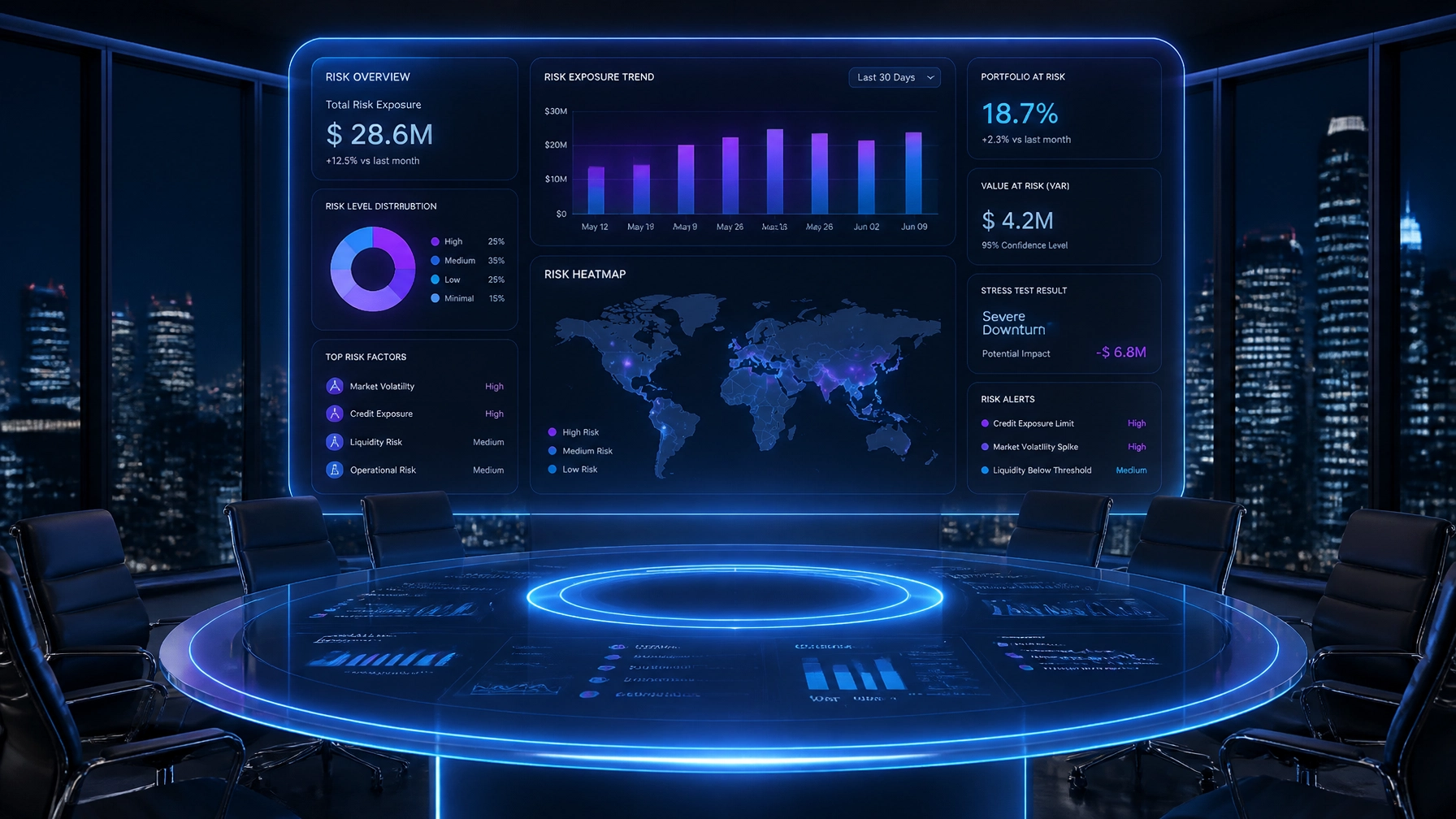
Picture this: You’re in a high-stakes boardroom in DIFC or Abu Dhabi Global Market. The air is thick with the scent of expensive espresso and the weight of multi-billion dirham decisions. You, the CISO, stand up to present. You pull up a slide. It’s a "Heatmap."
It’s a grid of red, amber, and green squares. You start talking about "high-probability vulnerabilities" and "patching cycles."
The CEO checks their watch. The CFO is looking at their phone. The Board of Directors? They’re nodding politely, but they’ve effectively checked out. Why? Because you’re speaking "Technical Latin" in a room that only speaks "Financial English."
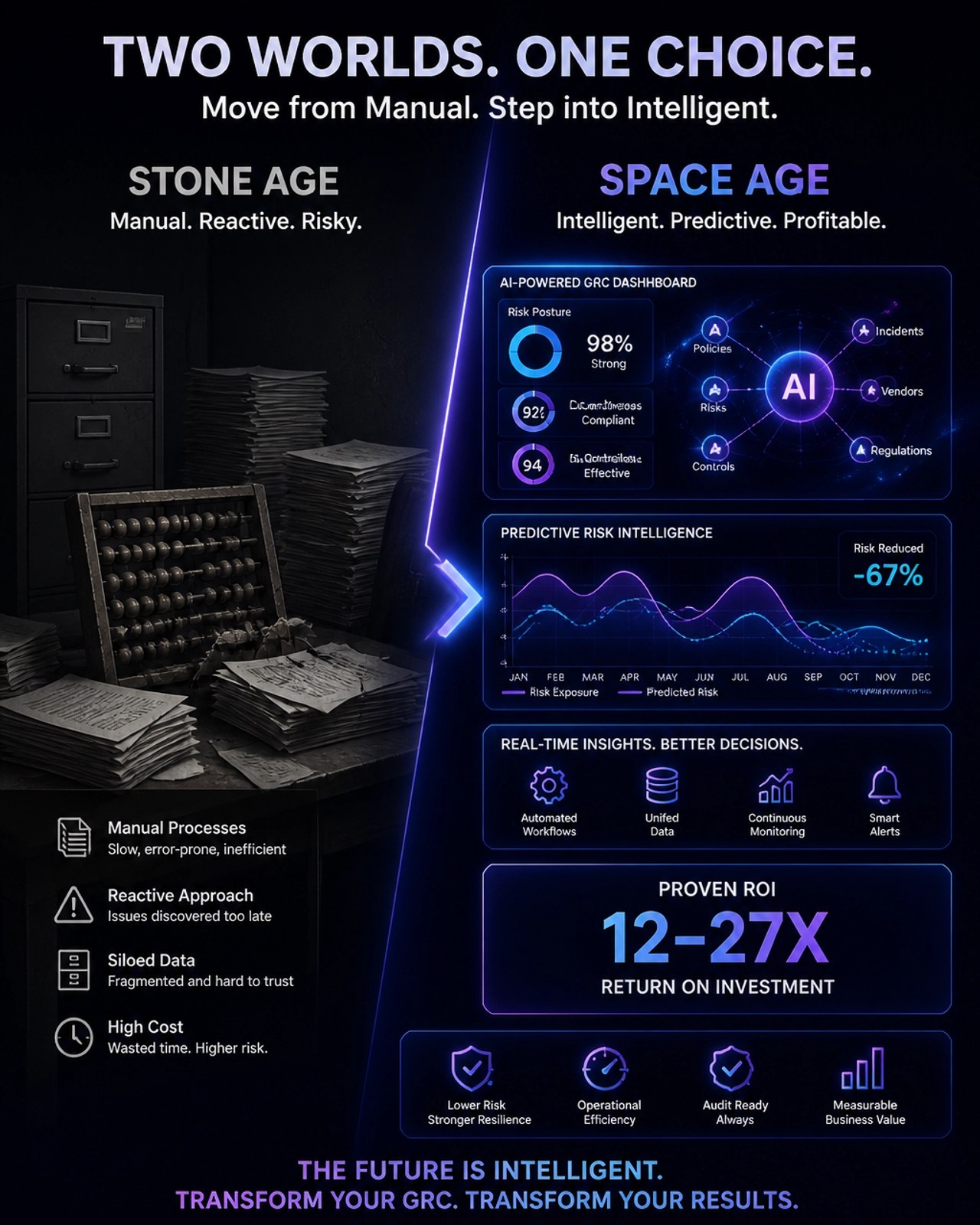
Welcome to the GRC Stone Age. If you’re still using spreadsheets, manual silos, and qualitative "gut-feeling" scores to manage risk, you aren’t just behind the curve, you’re practically carving your risk register into a cave wall with a blunt rock.
The Manual Misery: Why Your Spreadsheets are a Liability
In the modern operating reality, manual GRC is the ultimate anchor. It drags down decision velocity, swallows thousands of man-hours, and, worst of all, it's almost always wrong by the time the report is finished.
When you rely on manual practices, you face three critical failures:
- The Information Lag: By the time you’ve emailed fifteen different department heads and aggregated their Excel sheets, the data is four weeks old. In the cyber world, four weeks is an eternity.
- The Subjectivity Trap: One manager’s "High" risk is another’s "Medium." Without a standardized, data-driven yardstick, your risk posture is just a collection of opinions.
- The Checklist Fatigue: Manual GRC focuses on "checking the box." It treats compliance as the destination rather than the baseline. This leads to a false sense of security that evaporates the moment a real threat hits.
The Shift: From "Status Updates" to "Strategic Conversations"
The goal of a boardroom presentation shouldn't be to prove you've been busy. It should be to drive investment and prioritization.
To move from the "Stone Age" to "Risk Intelligence," you have to stop giving status updates and start having investment conversations. The board doesn't want to know how many firewalls you have; they want to know how much money is at risk and how much it will cost to protect it.
At Observeri, we call this the transition to Decision Velocity. It’s the ability to turn technical telemetry into a financial narrative that the C-suite can actually use to steer the ship.
Speaking the Board’s Language: The Math of Money
How do you stop the boardroom yawning? You talk about Expected Cyber Loss (ECL).
Stop saying "This asset is high risk." Start saying "This asset represents a 2.1 Million AED annualized exposure." Suddenly, the CFO is paying attention.
Observeri’s AI-powered engine automates this quantification using a rigorous, FAIR-style formula:
Expected Cyber Loss (ECL) = Probability of Incident × Financial Impact
We don’t just guess the impact. We calculate it based on:
- Daily Revenue (DR): What does this asset actually earn the company per hour?
- Estimated Downtime (DT): How long would it take to recover?
- Recovery & Legal Costs: Forensics, fines, and regulatory penalties.
- Reputational Multiplier: The long-term loss of customer trust.
When you present a risk as a dollar amount, you aren't just reporting a problem, you’re presenting a business case. You can show that a 150,000 AED investment in a specific control will reduce expected loss by 600,000 AED. That is a 300% ROI. That is a language the board understands.
Prioritization with Precision: The Asset Criticality Score (ACS)
In the Stone Age, everything is "Priority One." In the age of Risk Intelligence, we use the Asset Criticality Score (ACS) to separate the noise from the signal.
Not all servers are created equal. A printer in the marketing department does not carry the same weight as the Core Banking API. Our ACS model uses five dimensions to provide a 0–100 score that dictates where your team spends their next hour:
- Business Impact: Does this drive revenue?
- Data Sensitivity: Is there regulated or restricted data involved?
- Exposure Risk: Is it public-facing or isolated?
- Environment: Is it Production, UAT, or Dev?
- Lifecycle Fragility: Is it end-of-life or fully supported?
By automating this scoring, Observeri ensures that your remediation efforts are always aligned with the highest business value.

Why Automation is the Only Way Forward
You might be thinking, "We can do this math manually." Theoretically, yes. Practically? No.
The complexity of modern enterprise environments: ISO 27001, NIST CSF, SOC 2, and local UAE regulations like NESA: means that manual mapping is a fool’s errand. You’ll spend all your time calculating and zero time mitigating.
Observeri’s platform provides 12-27X ROI in the first year by:
- Compressing Audit Cycles: Moving from 7 weeks of manual evidence gathering to 3 days of automated validation.
- Predictive Risk Analytics: Using AI to predict potential breaches 30-90 days before they happen.
- Real-Time Visibility: A single "Management Spine" that connects governance, risk, and compliance into one automated workflow.
Conclusion: Leave the Rocks Behind
The "Stone Age" of GRC was about survival through spreadsheets. The "Risk Intelligence" age is about thriving through data.
When you walk into your next board meeting, don't bring a heatmap. Bring a financial narrative. Bring a prioritized roadmap based on Asset Criticality. Bring the certainty that comes with Observeri’s AI-driven automation.
Stop being a cost center that reports on "vulnerabilities." Start being a strategic partner that manages "investments." The board is waiting for a conversation they can actually join. Are you ready to lead it?
Ready to see your risk in Dirhams? Book a demo with Observeri today and move your GRC out of the caves and into the future.
Leave a Reply