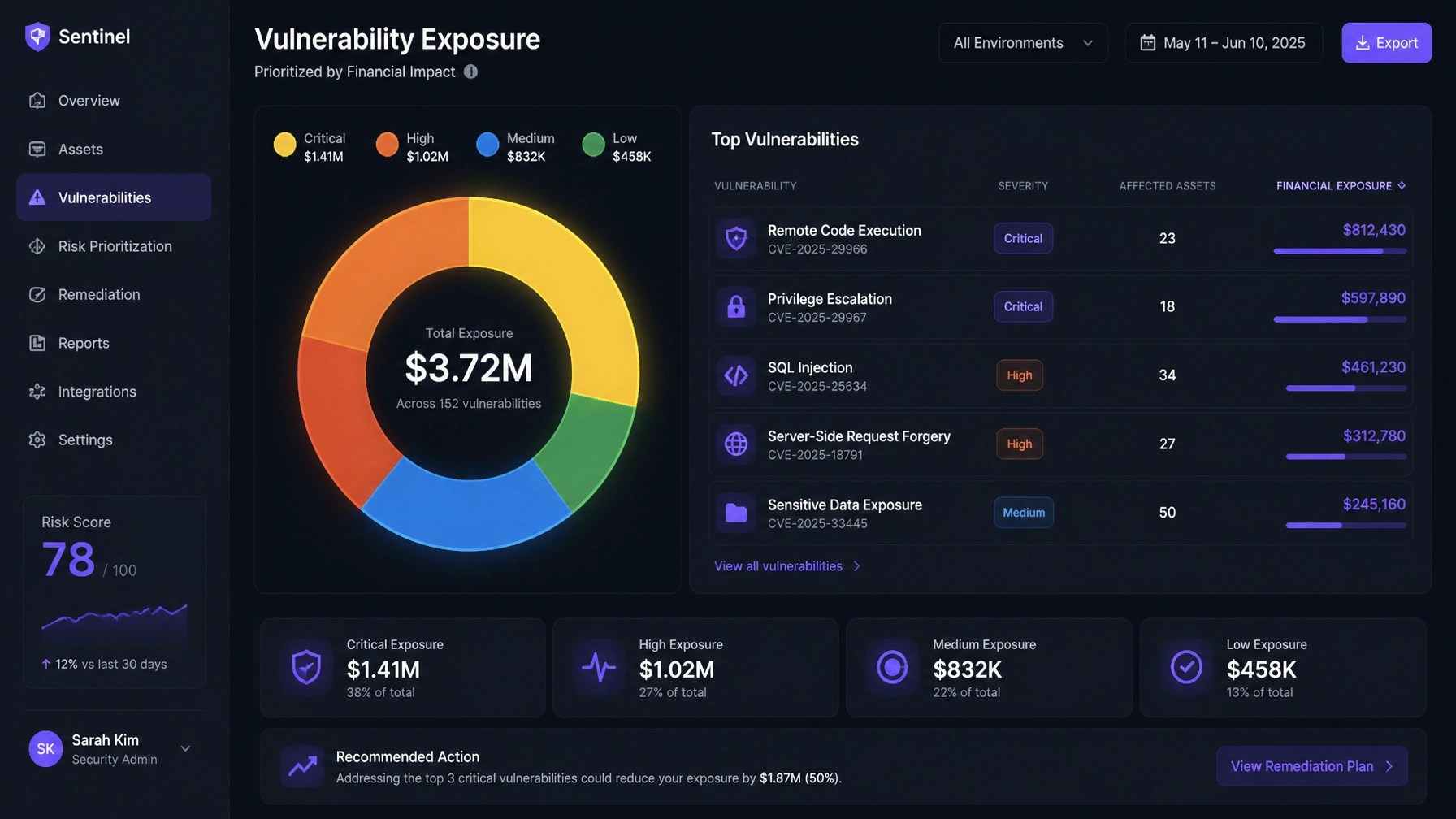
Let’s be honest: your security team is exhausted. They are currently sprinting on a hamster wheel of "Critical" and "High" vulnerabilities, fueled by nothing but cold coffee and the sheer terror of missing a 9.8 CVSS score. But here is the uncomfortable truth: patching everything is not a strategy; it is a clerical exercise.
Most CISOs are drowning in a sea of technical debt because they are using outdated prioritization models that treat all assets as equal. If a coffee machine and your core SQL database both have a Critical vulnerability, legacy tools tell you to patch both. Your team spends 40 hours a week "fixing things," yet your actual financial exposure barely moves.
It is time to stop playing whack-a-mole and start operating like a business leader. Here is how you shift from "patch-everything" fatigue to strategic risk reduction with Observeri.
The CVSS Trap: Why Technical Scores Are Lying to You
The Common Vulnerability Scoring System (CVSS) is a great technical baseline, but it is a terrible prioritization tool. Why? Because CVSS is context-blind. It tells you how "bad" a bug is in a vacuum, but it doesn't know where that bug lives or what it’s protecting.
When you prioritize based solely on CVSS:
- You waste resources: Your team spends weeks fixing vulnerabilities that are technically "Critical" but are sitting on isolated servers with zero path for exploitation.
- You ignore business impact: You might ignore a "Medium" vulnerability that, if exploited, could take down your entire payment gateway.
- You lose credibility with the Board: When the CFO asks, "How much risk did we actually reduce this month?" and you answer with "We patched 450 vulnerabilities," you aren't speaking their language. You’re talking about activities; they want to hear about outcomes.
Step 1: The Asset Criticality Score (ACS) – Defining What Matters
The first step to sanity is admitting that not all assets are created equal. Observeri’s Asset Criticality Score (ACS) model moves beyond the technical bug and looks at the business reality of the host.
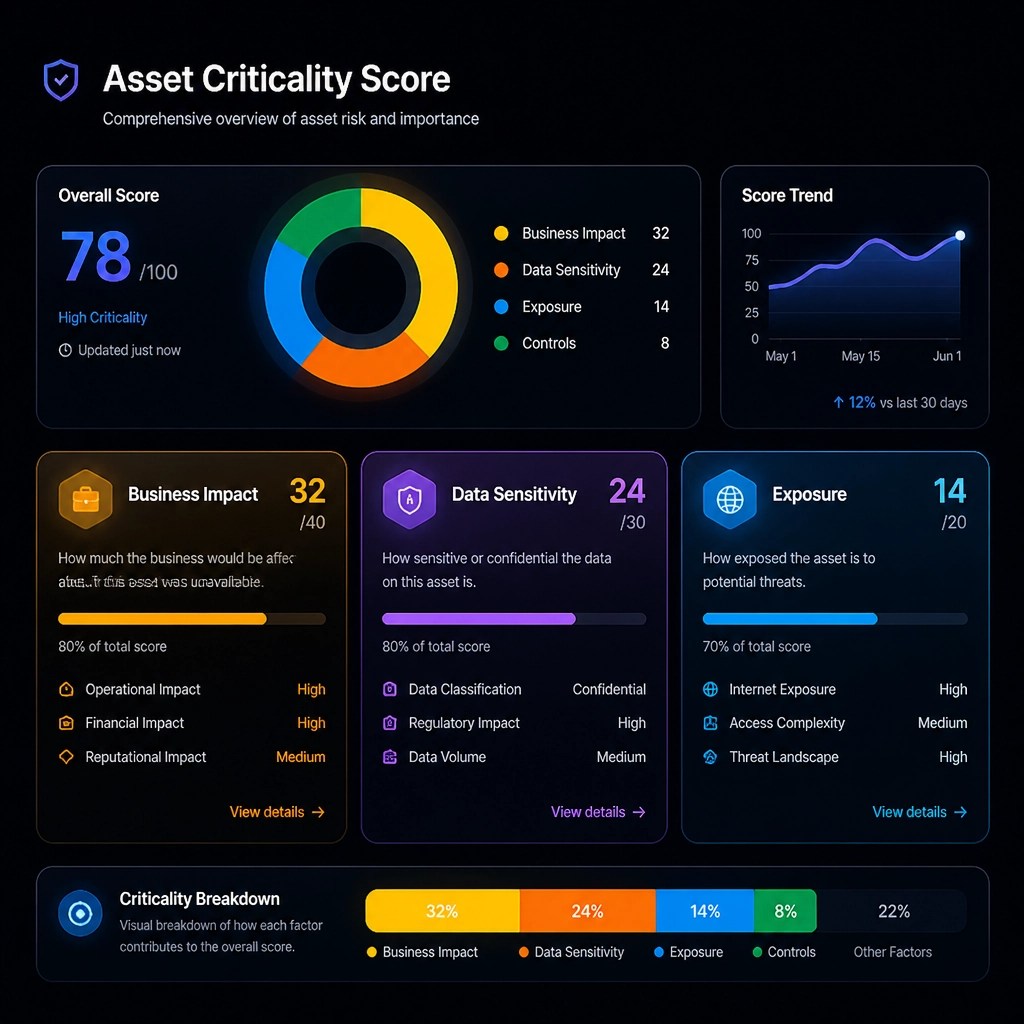
We calculate your ACS based on four primary pillars:
- Business Impact: If this asset goes down, does the company lose $10,000 an hour or $1,000,000? We map assets to your core business processes.
- Data Sensitivity: Does the asset house PII, PCI, or intellectual property? A server with 10 million credit card numbers has a higher ACS than your public-facing marketing site.
- Exposure: Is the asset internet-facing? Is it shielded by internal controls? We contextualize the "exploitability" based on your actual network topology.
- Redundancy: If this asset fails, do you have a failover? High redundancy lowers the criticality.
By combining these factors, Observeri assigns every asset a score. Suddenly, that "Critical" bug on a low-importance asset drops to the bottom of the list, while a "Medium" bug on your production crown jewels jumps to the top.
Step 2: Translating Risk into Dollars with Expected Cyber Loss (ECL)
CISOs often struggle to get budget approval because they can't quantify the "why." To a CFO, "Risk" is a vague term. "Dollars" is a metric they can bank on.
Observeri solves this by translating technical risks into Expected Cyber Loss (ECL). Using FAIR-style modeling (Factor Analysis of Information Risk), we take your vulnerability data, combine it with your ACS, and calculate the financial exposure in real dollar terms.
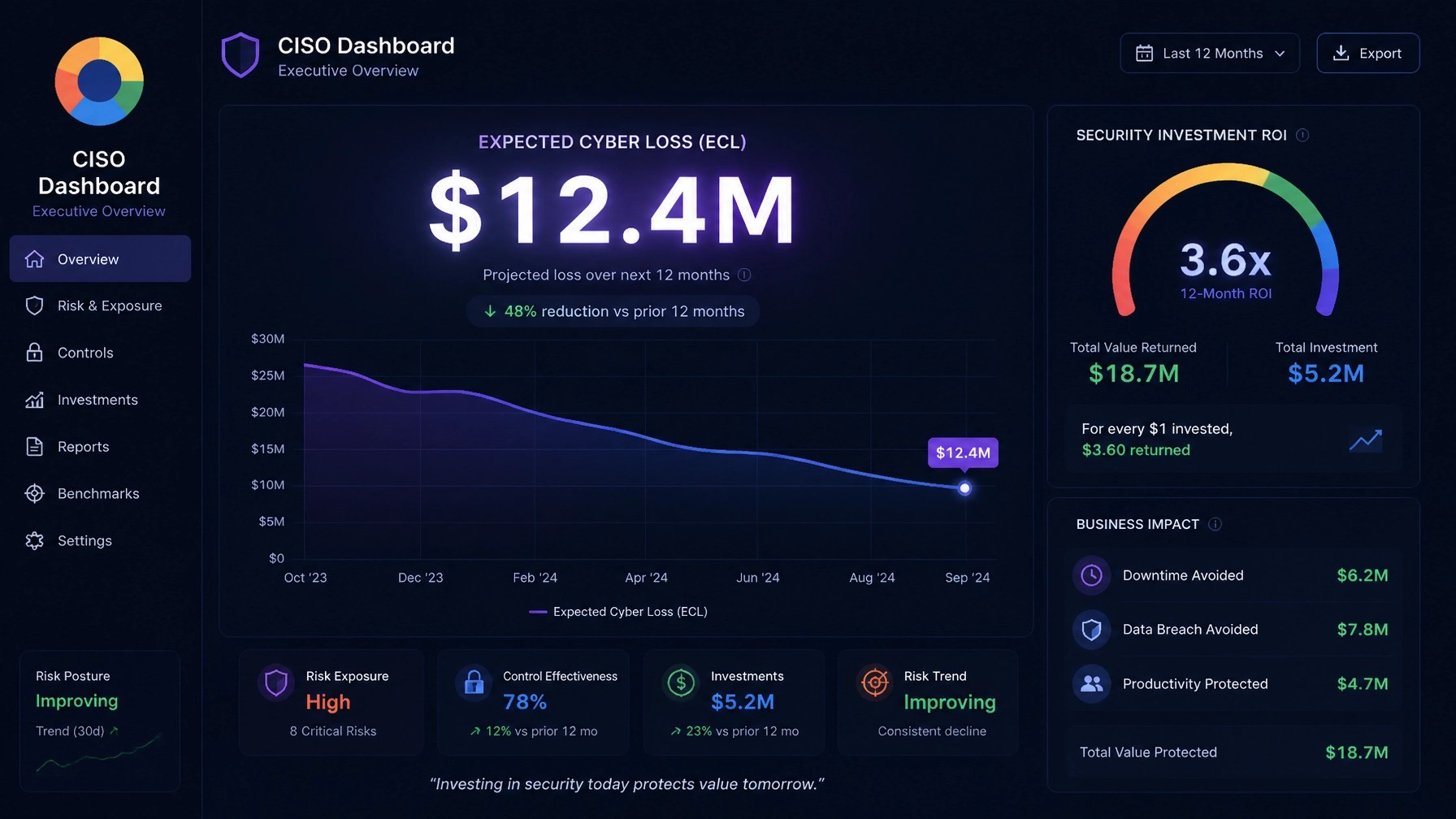
Instead of telling your Board, "Our risk score is 7.2," you can say:
"We have an Expected Cyber Loss of $4.2M due to unpatched vulnerabilities in our customer-facing API. By spending $50k on remediation this month, we can reduce that exposure to $1.1M."
That is a narrative the Board will sign off on every single time. It shifts the conversation from "security as a cost center" to "security as a value protector."
Step 3: The Residual Risk Score – Finding Your ROI
Not every patch is worth the effort. Some remediations are complex, require significant downtime, and only reduce your risk by a fraction of a percent.
Observeri introduces the Residual Risk Score. We help you visualize the "Before vs. After" of any remediation effort. Our platform calculates the ROI of every patch by comparing the cost of the fix (man-hours + downtime) against the reduction in Expected Cyber Loss.

By viewing your risk through the Observeri Insight Wheel, you can see exactly where your compliance and risk management efforts are overlapping. This integrated approach ensures that you aren't just "checking boxes" for ISO 27001 or SOC 2, but actually hardening your most valuable assets.
The Result: Decision Velocity
The ultimate goal of a modern GRC platform isn't just to find more problems; it’s to increase your Decision Velocity.
When you use Observeri, you stop debating which patches to apply. The data tells you. You stop guessing if your budget is well-spent. The ECL metrics prove it. You move from being a "firefighter" who is always reacting to the latest threat to a "strategist" who is proactively managing the company’s financial health.
| Legacy Approach | The Observeri Approach |
|---|---|
| Patch based on CVSS scores. | Patch based on Expected Cyber Loss ($). |
| All assets treated equally. | Asset Criticality Score (ACS) defines priority. |
| Compliance as a manual spreadsheet exercise. | Automated GRC mapping and evidence collection. |
| Security metrics are technical and abstract. | Security metrics are financial and strategic. |
| ROI is impossible to calculate. | 12-27X ROI in the first year. |
Conclusion: Stop Running, Start Leading
The "patch-everything" era is over. The sheer volume of vulnerabilities today makes it physically impossible to keep up. If you continue to try, you will lose your best talent to burnout and eventually experience a breach on an asset you didn't even know was critical.
Observeri provides the clarity you need to focus on what matters. By quantifying risk in financial terms and contextualizing vulnerabilities with asset criticality, we give you the tools to lead with confidence.
Ready to see your risk in dollars and cents? Book a demo with Observeri today and discover how our AI-powered platform can compress your audit cycles and maximize your security ROI.
Leave a Reply