For years, the relationship between the CISO and the Board of Directors has been defined by a fundamental language barrier. Security leaders speak in technical debt, vulnerabilities, and “High/Medium/Low” heatmaps. Boards speak in capital allocation, ROI, and financial exposure.
This disconnect is more than an administrative hurdle; it is a strategic liability. When risk is presented as an abstract score, cybersecurity remains a cost center: a defensive tax on the business. To transform security into a strategic driver, organizations must shift from qualitative guesswork to Cyber Risk Quantification (CRQ).
By implementing FAIR-style (Factor Analysis of Information Risk) modeling, enterprises can translate technical threats into a single, actionable metric: Expected Annual Loss (EAL). Here is how quantifying risk changes the boardroom narrative and why it is the only path forward for modern GRC.
The Failure of the Qualitative Heatmap
Traditional GRC methods rely on subjective assessments. A “High” risk in one department may be a “Medium” risk in another, depending entirely on the individual auditor’s perspective. For a CFO or CEO, these labels provide zero utility for decision-making.
- Subjectivity: Heatmaps are based on intuition, not data.
- Lack of Prioritization: When 50 items are “High Risk,” nothing is a priority.
- Static Nature: A heatmap is a snapshot of the past, failing to account for shifting threat landscapes.
Observeri’s platform replaces these colored squares with hard currency. By quantifying the frequency and magnitude of potential loss events, we provide a defensible financial narrative that aligns security spend with business objectives.

FAIR-Style Modeling: The Financial Logic of Security
At the core of a mature GRC platform is FAIR-style modeling. This framework breaks risk into two primary components: Loss Event Frequency and Loss Magnitude.
- Loss Event Frequency: How often is a specific threat likely to result in a successful breach?
- Loss Magnitude: What is the total financial impact, including primary losses (response costs, downtime) and secondary losses (fines, reputational damage, legal fees)?
By running these variables through thousands of Monte Carlo simulations, Observeri calculates the Expected Annual Loss. This allows the CISO to present a slide that says: “Our current exposure to ransomware in the UAE region is $4.2M EAL. With a $300k investment in automated control mapping, we can reduce that exposure by $1.8M.”
That is a conversation the Board wants to have.
From Cost Center to Strategic Business Driver
The primary goal of CRQ is to maximize Decision Velocity. When security investments are backed by financial data, the time-to-approval for critical projects drops significantly.
The ROI of Precision
Organizations using Observeri typically see a 12-27X ROI in the first year. This isn’t just from preventing breaches; it’s from optimized resource allocation. By identifying which risks have the highest financial impact, teams can stop wasting budget on low-value “checkbox” compliance and focus on the vulnerabilities that actually threaten the bottom line.
| Feature | Legacy GRC (Manual/Qualitative) | Observeri AI-Powered CRQ |
|---|---|---|
| Measurement | High/Medium/Low Scores | Expected Annual Loss ($) |
| Reporting Cycle | Annual or Semi-Annual | Continuous / Real-Time |
| Audit Cycles | 6-9 Months | Compressed by 50-80% |
| Predictive Power | Reactive (Post-incident) | Predictive (30-90 days out) |
| Strategic Value | Cost Center / Compliance Tax | Strategic Business Driver |
Predictive Analytics: Moving Beyond the Rearview Mirror
The boardroom is tired of hearing about what went wrong last quarter. They want to know what will happen next quarter.
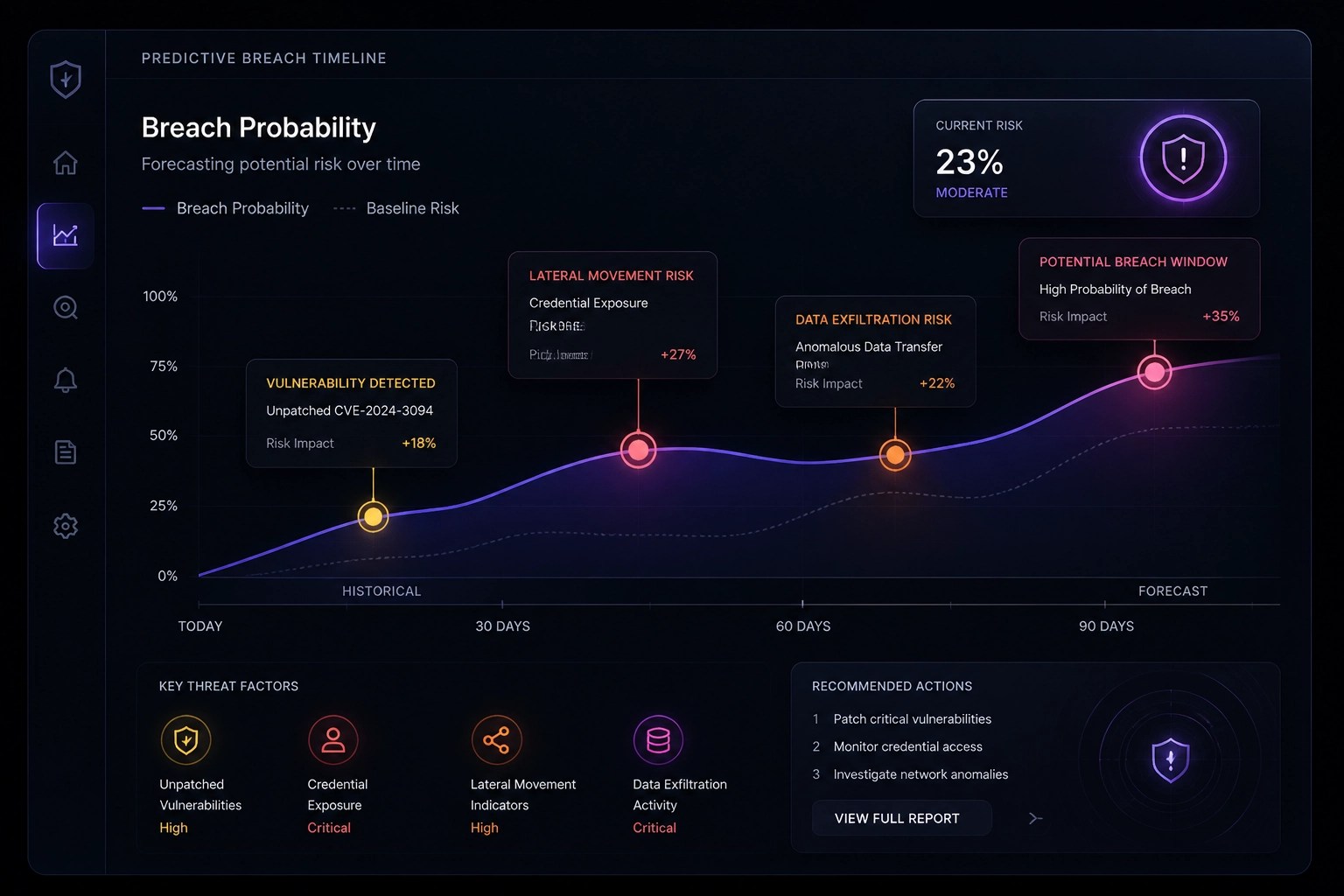
Observeri utilizes Predictive Risk Analytics to forecast potential breaches 30-90 days in advance. By analyzing internal control data alongside external threat intelligence, the platform identifies emerging patterns before they materialize into loss events. This shifts the enterprise from a reactive “firefighting” mode to a proactive, surgical remediation strategy.
Addressing the Stakeholders: A Unified Language
A quantified approach provides tailored benefits across the entire C-suite:
- For the CEO: Provides a clear picture of enterprise resilience and ensures security strategy supports global expansion and digital transformation goals.
- For the CFO: Translates “cyber risk” into a line item that can be balanced against insurance premiums and capital reserves. It justifies the budget through a lens of loss avoidance.
- For the CISO: Eliminates the “Fear, Uncertainty, and Doubt” (FUD) sales pitch. It builds credibility through data-driven reporting and defensible budget requests.
The Operating Reality
In regulated sectors like fintech, banking, and healthcare: especially within the UAE and the broader Middle East: compliance is not optional. However, compliance does not equal security. You can be 100% compliant and still face a catastrophic financial loss.
Observeri’s Automated Compliance Management continuously maps controls for ISO 27001, NIST CSF, and SOC 2, ensuring that compliance is a byproduct of a strong security posture, not the end goal. By automating the evidence collection and mapping, we free your security teams to focus on high-level risk strategy rather than spreadsheet administration.
Conclusion: The Cost of Inaction
The era of presenting technical vulnerabilities to the Board is over. Directors no longer want to know how many attacks you blocked; they want to know how much money is at risk and what the ROI is on the budget they’ve allocated.
Quantifying your cyber risk isn’t just a technical upgrade: it’s a career-defining shift for security leaders. It moves the conversation from “How much do you need?” to “How much are we saving?”
Ready to translate your security data into a financial narrative?
Discover how Observeri’s AI-powered platform can compress your audit cycles and quantify your risk in 21 days.
Leave a Reply